System Scope and Context
Business Context
The Agentic Layer operates within a broader enterprise ecosystem as a control plane that coordinates AI agents and their interactions with external systems. It is designed to integrate into existing enterprise infrastructure rather than replace it, providing AI orchestration while keeping organizational control over data and operations.
System Boundary
The Agentic Layer Platform Boundary defines the scope of components under direct control of the orchestration system. This includes the Kubernetes-native components for agent management, AI gateway services, governance tools, and operational interfaces. External systems remain independent and integrate through standardized protocols.
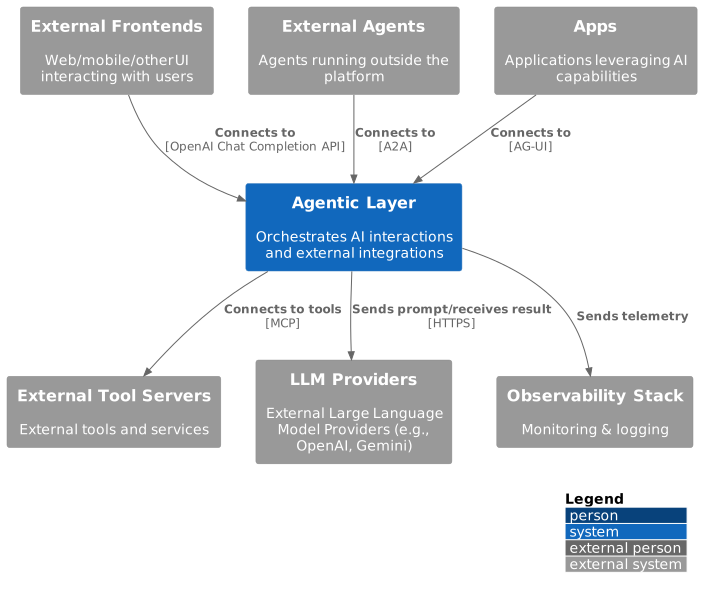
External Actors and Systems
External Frontends
Web, mobile, and other user-facing interfaces that connect to the Agentic Layer via the OpenAI Chat Completion API. They retain their own user experience and business logic and use the platform for AI interactions.
External Agents
AI agents running outside the platform that integrate with the Agentic Layer over the A2A (Agent-to-Agent) protocol. These can be existing AI systems, specialized agents, or third-party services that interact with platform-managed agents through a standardized protocol.
Apps
Applications that interact with the Agentic Layer via the AG-UI protocol. AG-UI provides a standardized interface for applications to communicate with agents and services managed by the Agentic Layer.
External Tool Servers
Tools and services exposed to agents through the MCP (Model Context Protocol). Examples include database access, file operations, and API integrations. The Agentic Layer’s Tool Gateway brokers these connections.
System Interactions
External System Connectivity
External systems interact with the Agentic Layer through protocol-specific entry points:
-
Via OpenAI Chat Completion API: External Frontends send requests using the OpenAI Chat Completion API
-
Via A2A: External Agents communicate over the Agent-to-Agent protocol
-
Via AG-UI: Apps connect over the AG-UI protocol
-
Via MCP: The Agentic Layer reaches External Tool Servers through the Model Context Protocol
AI Service Integration
The Agentic Layer mediates interactions with LLM providers through the AI Gateway, which:
-
Routes requests from agents to one or more LLM providers
-
Handles provider authentication and credential management
-
Supports both cloud-based and locally deployed language models
-
Collects usage telemetry for the requests it handles
Technical Context
The Agentic Layer acts as an integration hub rather than a data store. It orchestrates interactions between systems while maintaining a clear separation of concerns:
-
Stateless coordination: the platform focuses on coordination and routing rather than data storage
-
API-first integration: all interactions occur through defined APIs and standard protocols (A2A, MCP, AG-UI, OpenAI Chat Completion API)
-
Kubernetes-native deployment: components run as Kubernetes workloads and use Kubernetes primitives for scaling, service discovery, and operations