Building Block View
Overview
The Agentic Layer architecture is composed of the following top-level building blocks. Each block is a contract — usually one or more Custom Resource Definitions (CRDs) — that may have one or more implementations. The CRDs are defined by the Agent Runtime Operator; concrete implementations live in separate operator repositories.
-
Agent Runtime — hosts agents and manages their lifecycle. CRDs:
Agent,AgenticWorkforce,AgentRuntimeConfiguration. The Agent Runtime Operator reconciles these resources, supporting both template-based agents (operator-managed images) and custom-image agents, on top of any framework that speaks the A2A protocol. -
Agent Gateway — sits in front of the Agent Runtime. CRDs:
AgentGateway,AgentGatewayClass. Translates external protocols (OpenAI Chat Completion API, A2A, AG-UI) into the internal A2A surface used by agents, and routes requests to the appropriate agent. Current implementation: KrakenD, viaagent-gateway-krakend-operator. -
AI Gateway — model facade and provider abstraction. CRDs:
AiGateway,AiGatewayClass. Routes LLM requests to providers, manages credentials, and exposes telemetry. Current implementation: LiteLLM, viaai-gateway-litellm-operator. -
Tool Gateway — MCP traffic facade. CRDs:
ToolGateway,ToolGatewayClass, plusToolRoutefor per-consumer routing of tool calls. Current implementation: agentgateway, viatool-gateway-agentgateway. -
Tool Servers — MCP-speaking servers that expose tool capabilities. CRD:
ToolServer. Can be in-cluster Deployments managed by the Agent Runtime Operator, or external MCP servers registered asToolServerresources. -
Guardrails — content inspection and policy enforcement for traffic flowing through gateways. CRDs:
Guard,GuardrailProvider. The CRDs are the architectural contract; each gateway implementation chooses how to enforce them (either by delegating to an external adapter, or by configuring native gateway enforcement). -
Observability — ingests traces, metrics, and logs from the other building blocks and surfaces them through the Observability Dashboard.
-
Testbench — agent validation and evaluation environment. Connects through the Agent Gateway like any other client.
-
Compliance / Audit — captures audit records for governance and regulatory requirements. Planned.
Overall Request Flow
The following diagram shows how these building blocks interact during typical request processing:
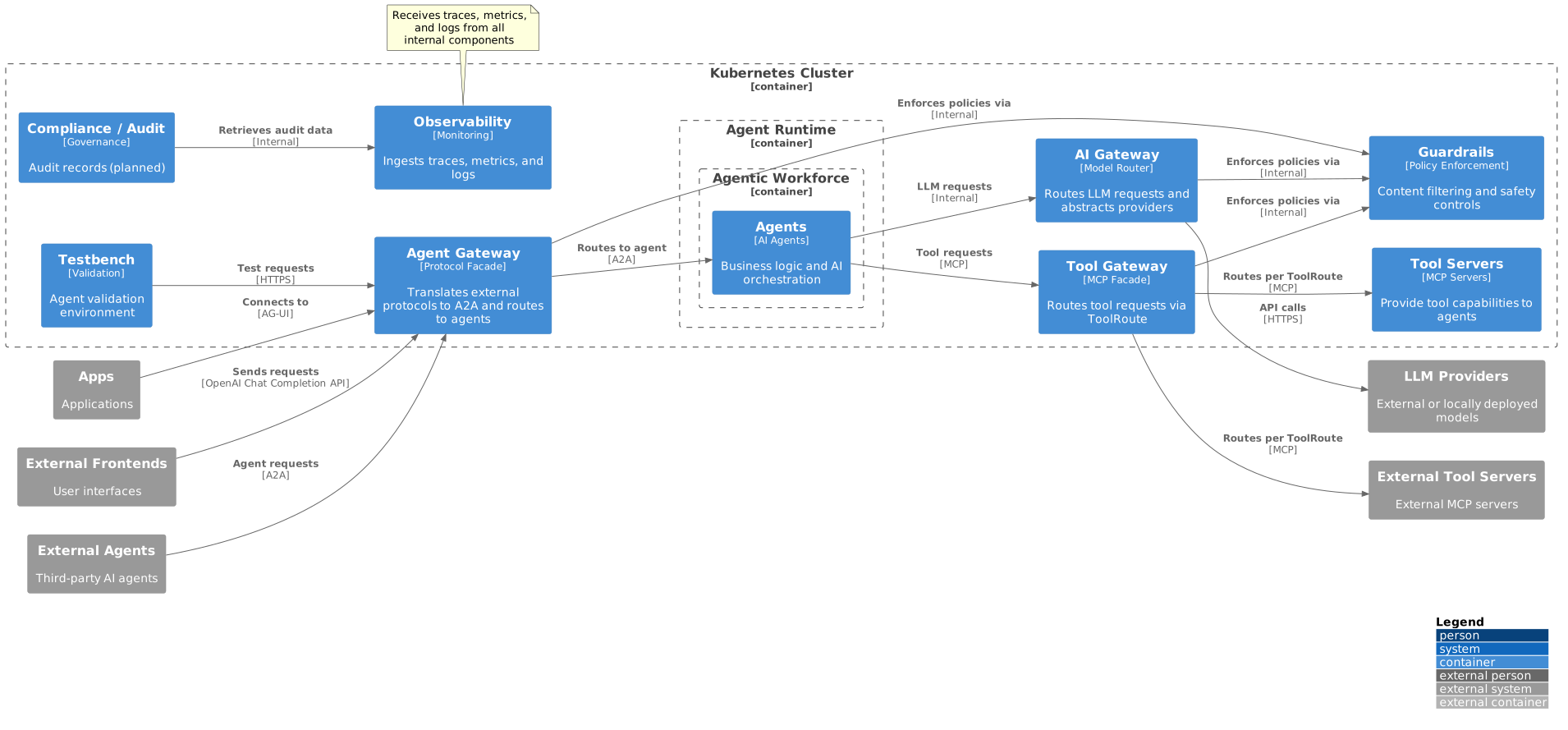
The flow:
-
External systems (Frontends, Agents, Apps) send requests via protocol-specific entry points (OpenAI Chat Completion API, A2A, AG-UI).
-
The Agent Gateway translates the incoming protocol into A2A and routes the request to the appropriate agent in the Agent Runtime.
-
Agents in the Agentic Workforce process the request, calling the AI Gateway for LLM access and the Tool Gateway for tool access.
-
The AI Gateway routes LLM calls to the configured provider; the Tool Gateway uses
ToolRouteresources to expose a per-consumer subset of the available Tool Servers. -
Guardrails are applied by each gateway according to the
Guardresources attached to it; how the gateway enforces those policies is an implementation concern. -
Observability collects telemetry from every component; Compliance / Audit (planned) will consume it for governance reporting.
-
The Testbench connects through the Agent Gateway like any other client.
Agent Runtime
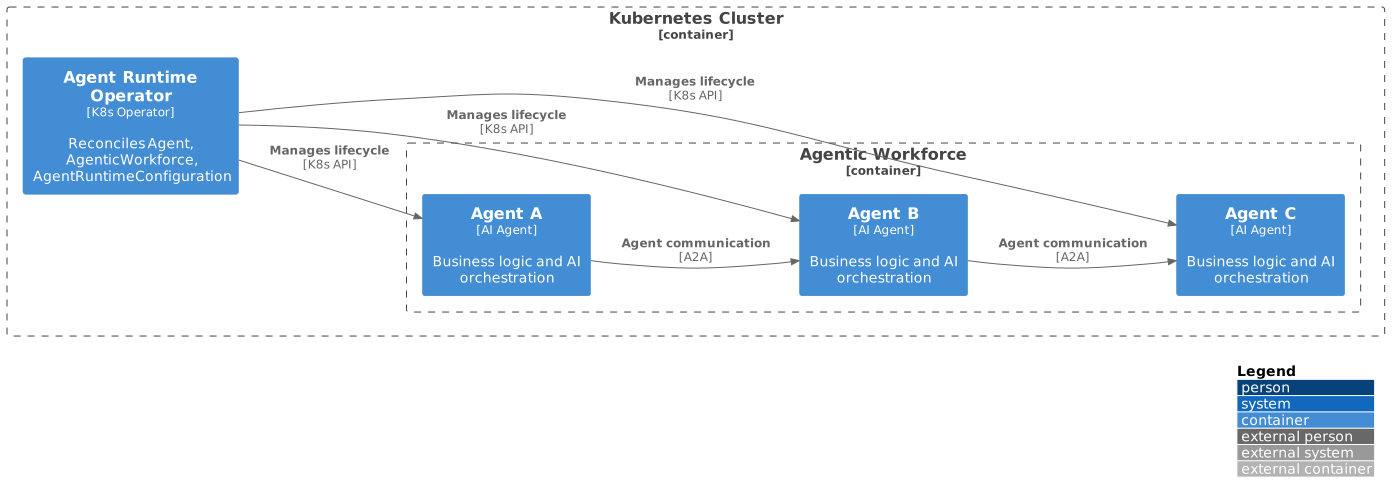
The Agent Runtime building block provides the execution environment and management infrastructure for AI agents within the Kubernetes cluster. It is reconciled by the Agent Runtime Operator and groups three CRDs.
Components
-
Agent Runtime Operator — Kubernetes operator that reconciles
Agent,AgenticWorkforce, andAgentRuntimeConfigurationresources, and owns the gateway CRDs that other operators implement. -
Agent (CRD) — declares a single agent workload. The operator creates a
DeploymentandServiceper agent. -
AgenticWorkforce (CRD) — declares a named group of entry-point agents. The operator crawls each entry point’s sub-agent graph and records all transitive agents and tools in
status. -
AgentRuntimeConfiguration (CRD) — namespace-scoped, operator-wide defaults (default framework, template images). One instance is allowed per operator namespace.
Multi-framework support
The Agent Runtime is framework-pluggable. Two deployment styles are supported:
-
Template-based agents declare
spec.framework(for examplegoogle-adkormsaf) and let the operator inject a framework-specific container image, system prompt, model, tool list, and sub-agent list via environment variables. Agents start as configuration, not as code. -
Custom-image agents set
spec.imageexplicitly. The operator deploys the supplied image and skips template injection. The container is responsible for implementing the A2A protocol on its declared port.
Both styles produce workloads that speak A2A, which is what the rest of the platform — Agent Gateway, sub-agents, Testbench — assumes on the wire.
Responsibilities
Agent Runtime Operator is the control plane for agent workloads:
-
Reconciles
AgentandAgenticWorkforceresources into KubernetesDeploymentsandServices. -
Resolves cross-references (
subAgents,tools,aiGatewayRef) and injects the resolved URLs into agent containers. -
Discovers transitive agents and tools in
AgenticWorkforce.statusso that other components (Testbench, dashboards) can inspect the workforce composition. -
Owns the CRDs (
AgentGateway,AiGateway,ToolGateway,ToolRoute,Guard,GuardrailProvider) that other operators reconcile; ships them as a stable, versioned API.
Agents are domain workloads:
-
Each agent runs as a Kubernetes
Deploymentand exposes A2A on a port declared inspec.protocols. -
Agents call the AI Gateway for LLM access and the Tool Gateway (or referenced Tool Servers / Tool Routes) for tool calls.
-
Agents communicate with each other via A2A;
subAgentsdeclare delegation targets either as in-clusterAgentreferences or remote agent-card URLs.
Agent Gateway
The Agent Gateway building block is the protocol-translating entry point for external traffic into the Agent Runtime. It is a separate building block — it does not run inside the Agent Runtime and is not part of any agent workload.
CRDs
-
AgentGateway(namespace-scoped) — declares a desired gateway instance: replicas, timeout, attached guardrails. -
AgentGatewayClass(cluster-scoped) — registers a named implementation controller. AnAgentGatewayselects its implementation viaspec.agentGatewayClassName.
Purpose
-
Protocol translation — accepts requests on external surfaces (OpenAI Chat Completion API, A2A, AG-UI) and converts them to the internal A2A protocol that agents implement.
-
Routing — dispatches each request to the appropriate agent within an
AgenticWorkforce. -
Cross-cutting concerns — applies any
Guardresources listed inspec.guardrails, providing a uniform place to enforce content policies on inbound traffic.
Pluggability
The AgentGateway / AgentGatewayClass pair mirrors the Kubernetes Gateway API. The CRDs are framework-agnostic; the underlying proxy is selected per resource. Current implementation: KrakenD, via agent-gateway-krakend-operator. Additional implementations can be added by registering a new AgentGatewayClass and deploying a controller that watches AgentGateway resources claiming that class.
AI Gateway
The AI Gateway building block is the model facade for the platform. It centralises LLM provider access so that agents call a stable cluster-local endpoint instead of carrying provider credentials and routing logic of their own.
CRDs
-
AiGateway(namespace-scoped) — declares the gateway instance: the list of available models (spec.aiModels), attached guardrails, port, environment. -
AiGatewayClass(cluster-scoped) — selects the implementation operator for this gateway.
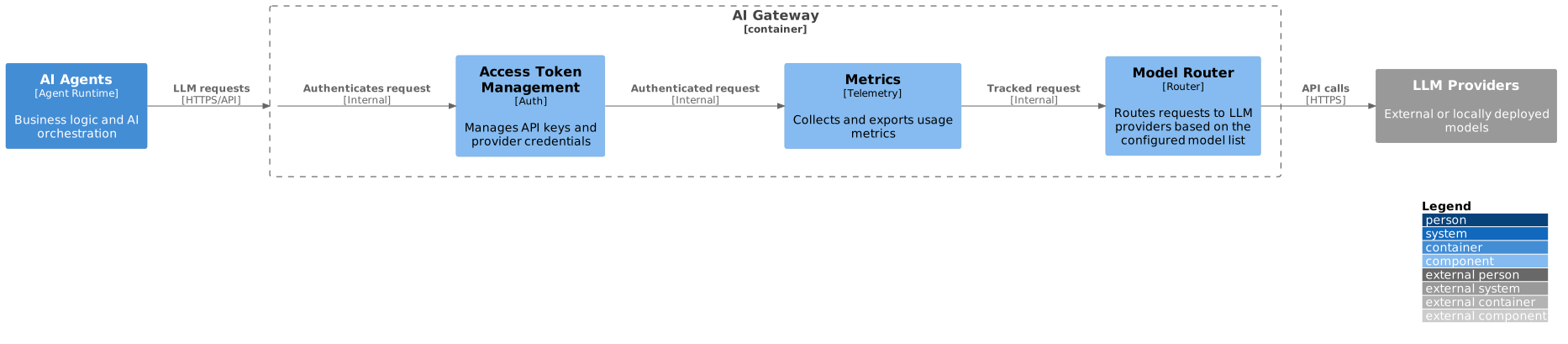
Components
Access Token Management holds provider credentials in a single Secret and injects them at request time, so individual agent pods do not carry LLM provider keys.
Metrics collects usage and performance data per model and per caller, and exports it to the Observability building block.
Model Router dispatches each request to the appropriate provider based on the model name and the spec.aiModels list. It supports both cloud-hosted providers (OpenAI, Anthropic, Gemini, Azure) and locally deployed models reachable from the cluster.
Guardrails are not part of the AI Gateway building block itself — they are an independent contract attached via spec.guardrails. See the Guardrails subsection below for how a gateway implementation enforces them.
Implementation
Current implementation: LiteLLM, via ai-gateway-litellm-operator. The operator reconciles AiGateway resources whose spec.aiGatewayClassName is litellm, deploys a LiteLLM proxy, and generates LiteLLM configuration from the declared model list. The same operator also reconciles ToolGateway resources.
Tool Gateway
The Tool Gateway building block is the MCP traffic facade. It gives agents a consistent endpoint for tool calls and is the place where per-consumer routing and centralised observability are applied to MCP traffic.
CRDs
-
ToolGateway(namespace-scoped) — declares a gateway instance. -
ToolGatewayClass(cluster-scoped) — selects the implementation operator. -
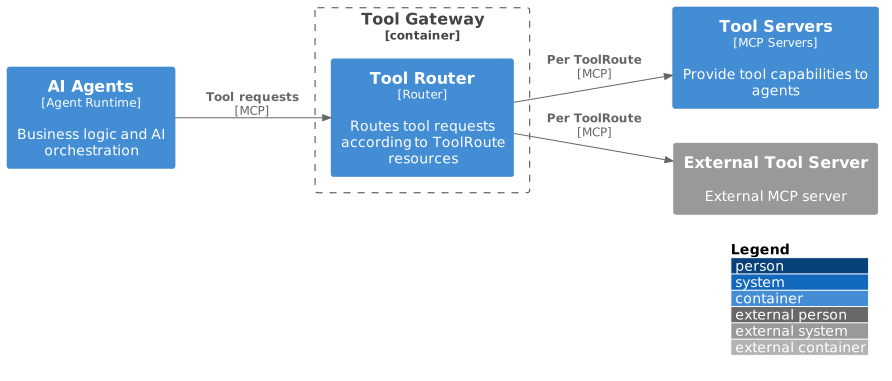
ToolRoute(namespace-scoped) — declares a per-consumer route from a gateway to one upstream MCP server (cluster-localToolServeror external URL).spec.toolFiltercan restrict the exposed tool set via allow / deny globs. The CRD is owned by the Agent Runtime Operator; the route is reconciled by the tool-gateway implementation operator that owns the referenced gateway.
ToolRoute is what makes the same physical tool catalog appear differently to different consumers: an agent that needs only read-only tools can be routed via a ToolRoute whose toolFilter denies destructive operations, while another agent in the same cluster can use a different ToolRoute to the same underlying ToolServer with broader access.
Responsibilities
-
Routing per ToolRoute — each
ToolRouteresource produces one addressable URL (populated onstatus.url) that anAgentcan reference viaspec.tools[].upstream.toolRouteRef. The route can target either an in-clusterToolServeror an external MCP URL. -
Tool filtering —
spec.toolFilteron aToolRoutenarrows the exposed tool set without changing the upstream server. -
Cross-cutting concerns —
spec.guardrailson theToolGatewaylets the platform attachGuardresources to all traffic flowing through the gateway.
Tool Servers
The Tool Servers building block holds the actual MCP servers that provide tool capabilities. It is separate from the Tool Gateway, which only routes to them.
CRD
-
ToolServer(namespace-scoped) — declares an MCP server. The operator creates aDeploymentandServiceperToolServerand populatesstatus.urlwith the cluster-local URL once the server is ready.
Internal and external tool servers
-
Internal — an in-cluster
Deploymentreconciled by the Agent Runtime Operator from aToolServerCR. The platform owns the workload, its image, replicas, and configuration. -
External — an existing MCP server outside the cluster, exposed to agents either via a
ToolRoutepointing at the external URL, or directly via anAgent.spec.tools[].upstream.externalreference. Agents do not see the distinction at call time; both styles look the same on the wire.
ToolServer complements ToolRoute: a ToolServer declares what an MCP server is and where it runs; a ToolRoute declares which consumers can see which subset of it through a given gateway.
Guardrails
The Guardrails building block is a content-inspection and policy-enforcement contract used by all three gateway CRDs. It is an independent building block, not a sub-component of any single gateway.
CRDs
-
GuardrailProvider(namespace-scoped) — declares where a guardrail backend lives and how to reach it. Supported provider types:presidio-api,openai-moderation-api,bedrock-api. -
Guard(namespace-scoped) — binds a provider to a concrete policy: when it runs (pre_call,post_call,during_call), which entities to check, what action to take (MASKorBLOCK), and at what confidence thresholds.
Every gateway CRD (AgentGateway, AiGateway, ToolGateway) exposes a uniform spec.guardrails field — an ordered list of Guard references. This is the architectural contract.
Implementation modes
The contract leaves room for two implementation styles, both of which the platform supports today:
-
Adapter mode — the gateway implementation delegates inspection to an external adapter. For example, the agentgateway-based tool-gateway operator deploys a
guardrail-adapterinstance per attachedGuardand wires it into the gateway via Envoy’s external processing mechanism. The adapter is the bridge between theGuard/GuardrailProvidercontract and the guardrail backend. -
Native mode — the gateway implementation enforces the checks itself, and the gateway operator translates
GuardandGuardrailProviderresources into the gateway’s native configuration format. For example, the LiteLLM-based AI gateway operator generates a LiteLLMguardrails:configuration block from the resolved CRs.
Which mode applies is a per-gateway concern documented on each gateway’s own explanation page. From the architecture’s point of view, both modes implement the same contract; agents, tool servers, and the platform never see the difference.
Observability
The Observability building block ingests traces, metrics, and logs from the other building blocks and surfaces them through the Observability Dashboard. The Agent Gateway, AI Gateway, Tool Gateway, agents, and tool servers all export telemetry to it; the Compliance / Audit building block consumes data from it once available.